The Arms Race Before the Bell: What OpenAI and Anthropic Are Really Doing Right Now
In the last seven days alone, the two biggest AI companies on the planet shipped, announced, acquired, partnered, and leaked more than most tech companies manage in a full quarter.
Make State of Brand one of your go-to sources on Google

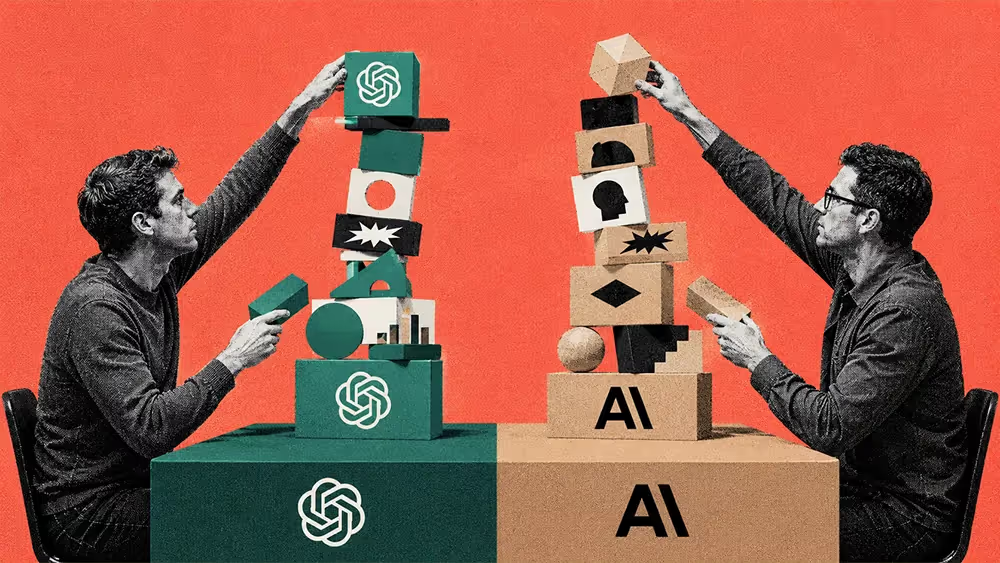
Every time a tech company is about to go public, the same thing happens. The announcements speed up. The partnerships pile on. Product launches start hitting so fast that even people who cover this stuff full time can barely keep track. It stops being about shipping things people need and starts being about telling a story. The story that will carry the company through investor meetings, Wall Street pitches, and eventually, a stock ticker.
OpenAI and Anthropic are both doing this right now. And they're doing it at a pace that's hard to overstate.
So What Actually Happened This Week?
In the last seven days alone, the two biggest AI companies on the planet shipped, announced, acquired, partnered, and leaked more than most tech companies manage in a full quarter. Let's break it down.
Anthropic's big moment was Project Glasswing. In plain terms: Anthropic took its most powerful unreleased AI model, called Claude Mythos Preview, and pointed it at the software that runs the internet. Working with about 50 partners including Microsoft, Apple, Google, and Cloudflare, the model found over 10,000 serious security holes in just one month. Cloudflare alone got back a list of 2,000 bugs. Mozilla used it to find and fix 271 problems in Firefox. And this wasn't just "hey, there might be a problem here" kind of finding. The model was actually building working attacks to prove the vulnerabilities were real.
Anthropic was blunt about what this means. Their AI can now find and exploit software weaknesses better than almost any human security expert alive. That's a wild sentence to write, but the data backs it up.
Then the leaks started showing up. Developers spotted references to something called "claude-mythos-1-preview" buried in Anthropic's code, in their security tools, and on both Amazon Web Services and Google Cloud. A few users even saw "Mythos 1" flash briefly in the regular Claude interface before it disappeared. Anthropic hasn't said when it's coming out, but all signs point to this model getting closer to a public release. The only thing holding it back, according to the company, is making sure it can't be misused.
On top of that, Anthropic bought a company called Stainless for over $300 million. If you're not a developer, here's why that matters: Stainless builds the tools that let AI assistants talk to other software. Think of it like buying the company that makes all the adapters and plugs. In a world where AI is about to start doing real work inside business software, owning that connector layer is a big deal. It's like owning the roads before everyone starts driving. The open protocol that makes all of this work, called MCP, has already crossed 97 million monthly downloads and been adopted by every major AI provider including OpenAI and Google.
And they weren't done. Anthropic also announced a $200 million partnership with the Gates Foundation for global health and education. They signed a deal putting Claude into the hands of all 276,000 KPMG employees. They launched Claude for Small Business, plugging directly into tools like QuickBooks, PayPal, HubSpot, and Docusign. They doubled the usage limits on Claude Code for paying customers. And Andrej Karpathy, one of the most well-known AI researchers in the world who previously helped build Tesla's self-driving program, announced he was joining the company.
Over at OpenAI, the biggest news was financial. Reports broke that the company started working on a confidential IPO filing with the SEC, possibly as early as May 22. Goldman Sachs and Morgan Stanley are running the process. The target is to go public by the end of 2026, at a valuation that could hit $1 trillion. This comes after OpenAI's record-breaking $122 billion funding round in March at an $852 billion valuation.
On the product side, OpenAI pushed its coding tool Codex into the ChatGPT phone app for both iPhone and Android, and made it available to everyone, including free users. Over 4 million people now use Codex every week. They expanded ChatGPT ads into the UK, Mexico, Brazil, Japan, and South Korea. They launched personal finance features for Pro subscribers that let you connect your bank accounts through Plaid and ask ChatGPT questions about your spending across over 12,000 financial institutions. They partnered with Dell to bring Codex into corporate data centers. And they released new voice AI models that can reason, translate, and transcribe speech in real time.
All of that in seven days.
Why Everything Is Happening At Once
Both of these companies are racing toward IPOs that will shape how investors value AI for the next decade. OpenAI wants to go public at up to $1 trillion. Anthropic is closing what might be its last private fundraising round at around $900 billion, with its own IPO possibly landing as early as October. On private trading markets, Anthropic shares were already changing hands at prices that implied a $1 trillion valuation earlier this month.
Here's the tension: both companies are losing massive amounts of money. OpenAI is expected to lose about $14 billion this year. At the same time, both are growing revenue at a speed that has basically no comparison in business history. OpenAI says it's pulling in $2 billion a month. Anthropic crossed $30 billion in annual recurring revenue earlier this year.
So every announcement you see in a week like this one is doing double duty. Yes, Codex on your phone genuinely helps developers get things done. Yes, Project Glasswing is a real and important security effort. But each of these also answers a question that an investment banker is going to ask during a roadshow: Where's the moat? Where's the growth? Why should investors pay what you're asking?
The Stainless acquisition isn't just about making better developer tools. It's about being able to tell investors that when the world runs on AI agents doing work inside business software, the connective plumbing runs through Anthropic. The ChatGPT finance feature isn't just about helping you see your spending. It's about proving that ChatGPT could become the front door to financial services, which is a market worth trillions. The KPMG deal and Gates Foundation partnership aren't just about doing good work (though they are that too). They're about showing that you've penetrated the enterprise and earned social trust at a scale that public market investors need to see.
This is the brand-building phase. Both companies know exactly what they're doing.
Why Mythos Changes the Conversation
Out of everything that happened this week, Mythos is the one that deserves the most attention. If the Glasswing results are even close to representative of what this model can do broadly, the implications go way beyond cybersecurity.
We're talking about an AI that can find and exploit security flaws in every major operating system and web browser, and that has already done this at scale across dozens of the world's biggest tech companies. Anthropic's own warning was striking: the AI finds vulnerabilities faster than humans can fix them. Microsoft acknowledged that the volume of patches coming is only going to grow.
From a branding perspective, this is Anthropic pulling off something that neither OpenAI nor Google has managed as cleanly. They've turned a safety risk into a selling point. The message isn't just "our model is powerful." It's "our model is so powerful that we have to be careful about how we release it." That kind of restraint, whether it's driven by genuine caution or smart positioning or both, creates a brand identity that lands differently with big corporate buyers and regulators. It says: we take consequences seriously.
And the fact that Mythos 1 is leaking out through code references and brief UI appearances rather than getting a polished launch event? That only builds more anticipation. Controlled scarcity, whether it's intentional or not, is one of the oldest and most effective moves in brand building.
The People Using This Stuff Are the Real Winners
Here's what gets buried under all the IPO talk and valuation one-upmanship: the people actually using these tools every day are living through the best stretch of product improvement any of us have seen.
A developer sitting on a train can push code to GitHub from their phone, have Codex build the feature, run the tests, and send it back for review. All without opening a laptop. A small business owner can wire Claude into QuickBooks, PayPal, and HubSpot and automate their month-end financial close without hiring an accountant. A security team can point Mythos at their codebase and find problems that would have taken a roomful of experts months to uncover. A nonprofit focused on public health can tap into frontier AI through a $200 million commitment that didn't exist two weeks ago.
The competition between these two companies, with Google's Gemini and the open-source world pushing from the sides, is creating a pace of improvement that flows directly to the people building with these tools. When OpenAI puts Codex on phones, Anthropic ships mobile features for Claude Cowork. When Anthropic buys Stainless and locks down the connector layer, OpenAI integrates the same open protocol into its own tools. Each move forces the other to respond, and every response makes the products better for everyone.
This is the best version of what IPO pressure can produce. The companies are competing to tell a story, but the byproducts of that competition, the actual products and integrations and partnerships, create real and growing value for the rest of us.
What Comes Next
The next 90 days are going to be decisive. If OpenAI's confidential filing turns into a public one by late summer, we'll see a company trying to pull off the largest tech IPO ever while still burning billions a year. If Anthropic closes its $50 billion round at $900 billion and moves toward its own listing, we could see two direct competitors go public in the same quarter. That almost never happens, and it would force every investor to pick a side, not just on a company, but on a philosophy.
The brand strategies could not be more different. OpenAI has chosen reach: 900 million weekly users, ads in the product, personal finance, a "super app" that bundles everything together. Anthropic has chosen trust and depth: big enterprise partnerships, safety-first positioning, cybersecurity as proof of capability, and a corporate structure built around public benefit.
Both strategies make sense. Both are working. And both are pumping out value for the people who actually use what they're building.
The arms race before the bell isn't just performance. It's producing the future, one week at a time.

If this caught your attention, that’s not accidental.

The best editorial systems don’t happen by accident. Outlever builds them.

If this caught your attention, that’s not accidental.

The best editorial systems don’t happen by accident. Outlever builds them.

Come back for the reason it lands.
Subscribe for the kind of thinking that makes people stop, read and come back.