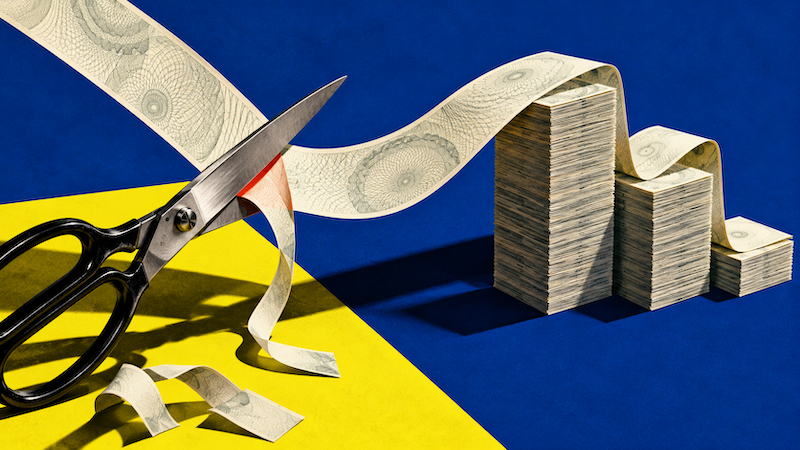
The content tooling market has never been more crowded, and content has never traveled worse. Those two facts are related.
The market for content creation software is now worth nearly $20 billion, according to industry estimates, and analysts project it will more than double over the next decade. Hundreds of products compete inside it: writing assistants, video repurposing engines, podcast clipping tools, blog generators, carousel makers, newsletter builders. The pitch varies by category but reduces to the same sentence. Create more, in less time, at lower cost.
By most accounts, the tools deliver. The marginal cost of producing a competent blog post, a serviceable video, or a plausible thought-leadership thread has collapsed to nearly zero. Production is a solved problem, and it has been for a while.
That is exactly why it stopped mattering. When every brand can produce infinite content, production is no longer the bottleneck, and it is no longer an advantage. The constraint has moved to the other side of the equation: getting anyone to see, trust, and act on what gets made.
That's distribution. Almost nobody is building for it.
The great mismatch
The math of the modern content economy is uncomfortable. Supply is growing exponentially while human attention stays fixed, which means every tool that makes creation cheaper makes the attention market more competitive, not less. An entire industry has become extraordinarily good at manufacturing the product and structurally indifferent to whether it ever reaches a customer.
The equivalent in any physical industry would be obvious malpractice: faster assembly lines, cheaper raw materials, record output per hour, and the finished goods stacked in the parking lot waiting for trucks that never arrive.
Inside marketing departments, the symptoms are consistent. Blogs publish three times a week to flat traffic. LinkedIn posts go out on schedule and reach a few hundred of the same people, while organic reach keeps declining across social platforms, with industry benchmarks putting Facebook's organic reach for business pages below 5% of followers. Whitepapers get gated, promoted for two weeks, and forgotten. The content calendar stays full while the pipeline impact rounds to zero.
The industry's standard response has been more production. Post more, test more formats, repurpose harder. It is the one lever every vendor sells, so it is the one lever teams keep pulling, even as returns diminish in real time.
Why nobody builds distribution products
If distribution is the real problem, the obvious question is why the market remains so lopsided. Several structural reasons explain it.
Creation is easy to productize and distribution is not. A writing tool has clean inputs and outputs: prompt in, draft out. Distribution runs through relationships, editorial judgment, algorithmic platforms outside any vendor's control, and audiences that have to be earned one credible touchpoint at a time. None of that wraps neatly into a subscription and a free trial.
The platforms that once served as the de facto distribution answer are also closing. For fifteen years, marketers outsourced reach to Google and the social networks, and that arrangement is unraveling. Pew Research Center found that when Google's AI Overviews appear, only 8% of users click through to an external site, roughly half the rate of searches without them. Similarweb data shows the share of news searches ending without any click grew from 56% to nearly 69% in the year after AI Overviews launched. The casualties are not small blogs: Business Insider's organic search traffic fell 55% between 2022 and 2025, and HuffPost lost half its search referrals over the same period. Reach that brands spent a decade building on borrowed land is being quietly repossessed.
There is a third factor: distribution failure is deniable. When content underperforms, the content itself absorbs the blame, whether the hook, the format, or the topic. Teams iterate on creation indefinitely, and the actual failure point never gets examined.
The result is a strange equilibrium in which the industry keeps optimizing the solved half of the problem because the unsolved half is hard.
Distribution is not "posting"
Part of the confusion is definitional. Most of what gets labeled distribution strategy is publishing logistics: scheduling tools, cross-posting, hashtag hygiene. Volume tactics with better dashboards.
Real distribution answers a harder set of questions. Which specific people need to encounter a piece of content, in what context they will trust it, through whose voice it arrives credibly, and what brings them back without a retargeting budget.
Answered honestly, those questions turn distribution from a promotion problem into a media problem. The organizations that have always solved it, the ones whose content audiences seek out rather than scroll past, are publications. They carry an identity readers recognize, editorial standards readers trust, and a compounding audience relationship no algorithm can revoke.
That's the real solve. Not another creation tool or a louder megaphone, but becoming the destination instead of the interruption: owned media with actual journalistic gravity, moved through the channels where buyers genuinely pay attention. The Slack share. The forwarded email. The message that says "you should read this."
The publication is the strategy
The most consequential shift in B2B right now has nothing to do with a new format or platform. Brands are quietly turning themselves into newsrooms, hiring editorial talent, interviewing the people they want to reach, and publishing reporting their industries actually cite. Not content marketing wearing journalism's clothes. The real thing, with a masthead.
The model works for a reason the creation-tool economy cannot replicate: a publication is itself a distribution asset. Every credible article compounds the audience. Every expert interviewed becomes a reader, a sharer, and often a buyer. The reporting builds the reach, and the reach makes the next piece of reporting land harder. Creation and distribution stop being separate line items and become one flywheel.
The State of Brand is a working version of that thesis. The publication exists because the answer to the distribution problem was never another tool. It was an owned newsroom, built deliberately and treated as the destination. Any reader who arrived here through a feed, an inbox, or a colleague's message has watched the point make itself.
Where this goes
The creation gold rush will run for a while yet. Tools will improve, output will get cheaper, and feeds will get fuller. None of it changes the arithmetic: attention is the scarce resource, and scarcity is where the value lives.
The brands that win the next decade will not be the ones that produced the most. They will be the ones that built somewhere worth going and made sure the right people knew the way there.
Everyone has a content solution. Distribution is still up for grabs, and that gap is the entire market.