





powered by




Anthropic's announcement on Monday isn't just a joint venture. It's a blueprint for a new operating model, one where every product and tech company builds, owns, and deploys AI trained on its own data.
Anthropic's announcement on Monday isn't just a joint venture. It's a blueprint for a new operating model, one where every product and tech company builds, owns, and deploys AI trained on its own data. And once that door opens, it doesn't close.
The venture, valued at $1.5 billion with founding partners Blackstone, Hellman & Friedman, and Goldman Sachs, isn't selling companies access to a chatbot. It's embedding engineers inside enterprises to build AI systems shaped by proprietary workflows, proprietary data, and proprietary outcomes. That's a different game entirely.
Up to this point, enterprise AI adoption has mostly meant plugging into someone else's platform. You call an API. You use a general-purpose model. You hope it works for your use case. The Anthropic venture flips that relationship.
From the announcement:
"An engagement might begin with the company's engineering team sitting down with clinicians and IT staff to build tools that fit into the workflows that staff already use… Engagements like this will run across mid-sized companies across industries, each shaped by the people closest to the work."
What Anthropic is describing here is a model where forward-deployed engineers sit inside your company, learn your operations, and build AI systems that run on your data. Every enterprise that goes through this process walks away with something no competitor can replicate: AI tools trained and fine-tuned on their own institutional knowledge, their own customer patterns, their own operational logic.
This isn't AI as a service. This is AI as infrastructure, and the company that builds it first owns an advantage that widens every day the system runs.
Think about what happens next. Once a healthcare company deploys AI built on its own clinical data, that system becomes the standard for how the organization operates. Workflows reshape around it. Decisions route through it. New hires are trained on it. The AI stops supporting the process and becomes the process.
Now multiply that across the portfolio companies of Blackstone, Goldman Sachs, Apollo Global Management, General Atlantic, and the rest of the investor coalition backing this venture. Each of those firms controls dozens, sometimes hundreds, of companies across every sector. When the private equity firm that owns you tells you there's a proven deployment model with embedded engineering support and your peers are already running it, adoption isn't optional. It's operational gravity.
Standards don't get set by committee. They get set by capital. And Anthropic just secured the capital to set them.
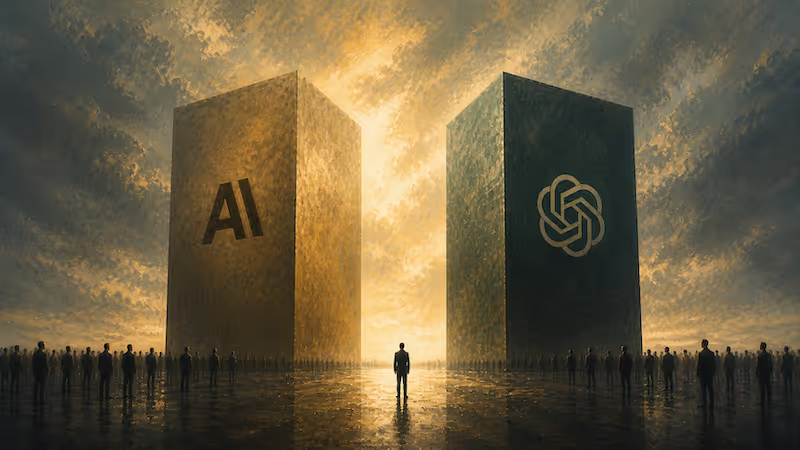
OpenAI moved on the same day, which tells you this isn't a one-off play. Bloomberg reported that OpenAI is finalizing its own $10 billion venture, The Development Company, with 19 investors including TPG, Brookfield Asset Management, Advent, and Bain Capital. There's zero investor overlap between the two ventures, which means the financial world has split into two camps, each betting that embedded, data-driven AI deployment is the future of enterprise operations.
Both ventures follow the same logic: partner with asset managers who control massive portfolios of companies, embed AI engineers inside those companies, and build systems that run on proprietary data. The companies that go through this process won't just be "using AI." They'll be running different businesses, faster, leaner, and locked into an ecosystem that compounds over time.
If you're building products or running a tech company, this is the moment to pay close attention to what's actually happening.
Data becomes the product differentiator, not the model. The base models are converging. What separates companies going forward is the training data they accumulate through deployment. Every customer interaction, every workflow optimization, every edge case an embedded engineer solves feeds back into a system that gets smarter and more specific to that business. Companies that start this process now build a compounding advantage that latecomers can't shortcut.
Operations standardize around AI, not around legacy software. The ERP era gave us standardized business processes built around software like SAP and Oracle. This venture model does the same thing, but with AI as the operating layer. Once your supply chain, your customer service, your clinical workflows are running through AI systems trained on your own data, switching costs become enormous. The standard isn't the model. The standard is your model, and it's woven into everything.
The build-versus-buy equation just collapsed. You're no longer choosing between building an internal AI team or buying off-the-shelf tools. The joint venture model gives you embedded engineers who build with you, then leave you with a system that's yours. That hybrid didn't exist at scale before this week. Every product roadmap in enterprise tech needs to account for it.
The scale of capital flowing into this model is hard to overstate. Anthropic's venture is backed by $1.5 billion, with the company simultaneously pursuing a $50 billion funding round at a $900 billion valuation. OpenAI closed $122 billion in March at an $852 billion valuation and is now adding another $10 billion through its own venture.
This isn't venture capital optimism. The largest alternative asset managers on the planet, firms that manage trillions in real assets, are deciding that AI deployment inside their portfolio companies is worth billions in dedicated capital. When Blackstone and Goldman Sachs commit $300 million each to a deployment venture, they're not making a bet on Anthropic's technology. They're making a bet that the companies they own will operate differently because of it.
Monday's announcement is the moment enterprise AI stopped being a tool companies adopt and started being the operating system companies run on. The joint venture model, with its embedded engineers, proprietary training data, and standardized deployment across portfolio companies, is going to change how product and tech companies build, compete, and scale.
Anthropic didn't just announce a partnership. It announced the new rules. And every company that waits to build its own data-driven AI infrastructure is handing a compounding advantage to the ones that started this week.


The best editorial systems don’t happen by accident. Outlever builds them.


The best editorial systems don’t happen by accident. Outlever builds them.

Subscribe for the kind of thinking that makes people stop, read and come back.