"Billboards can be beautiful."
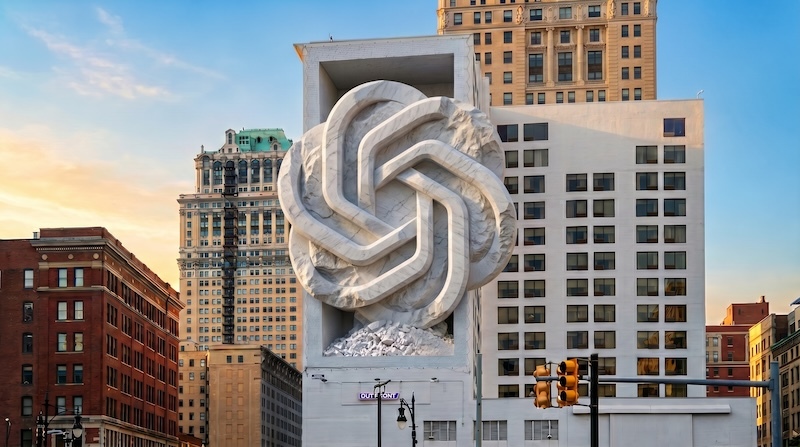
That's how Cary Hudson, design director at OpenAI, announced the company's newest out-of-home campaign on LinkedIn. In his post, Hudson describes the work as bringing image generation into the physical world, taking familiar outdoor formats and turning them into something more imaginative, surprising and alive. The campaign is now running in Detroit, New York, Chicago and Los Angeles under one line: Reimagine anything with ChatGPT Images.
It might be the smartest OOH buy of the year, and it didn't need a hero film or a celebrity to get there.
The medium is the demo
Advertising for creative tools usually runs into the same structural problem. You end up telling people the product is magic instead of showing them. Screenshots of a UI, a montage of outputs, a tagline about possibility. The audience has to take your word for it.
OpenAI got around that by making the billboard itself the output. One execution puts the word "chat" on one side of a clean blue field and "football" on the other, with a photorealistic football erupting through the middle of the copy, as if the prompt generated the object right there on the board. A format you've driven past ten thousand times suddenly behaves differently. You don't read a claim about what ChatGPT Images can do. You watch it do it, at forty feet wide.
No copywriter wrote a benefit statement for that board. The model did the talking.
A course correction, and a confident one
OpenAI's slice-of-life billboards earlier this year, the muted minimalist portraits of people mid-task, were met with genuine confusion. The design was so ambiguous that a parody billboard circulated online and fooled a large chunk of the internet, including design press, before anyone spotted it was fake. When your brand aesthetic is so quiet that a hoax is indistinguishable from your actual media buy, you have a distinctiveness problem.
The new work answers that critique without apologizing for it. The last campaign whispered. This one performs. The last campaign showed people using the product. This one shows the product's actual output: vivid, surprising, unmistakably generated. Nobody is parodying this work, because the work already does the most interesting version of itself.
The timing takes nerve, too. AI-generated imagery in advertising has spent two years as a punchline, between the slop discourse, the brand misfires and the six-fingered hands. OpenAI's response is to flaunt the generation rather than hide it. The bet is that these images can hold up on premium placements in the four most photographed media markets in America, and anyone walking past can decide whether they do.
Read the city list
Detroit, New York, Chicago, Los Angeles.
Detroit isn't a default buy for a tech brand campaign. It's a design city, a maker city, a place with an emotional relationship to reinvention. Putting "reimagine anything" on Detroit boards is the kind of media planning choice that does narrative work the creative doesn't have to. It says this campaign is about transformation as an idea instead of a feature.
What brand leaders should take from this
The strongest possible claim for any creative tool is a public demonstration. If your product makes things, let the product make the ads, visibly, with its name on it. A screenshot in a case study will never do what a real placement on Woodward Avenue does.
Format subversion also beats format polish. OOH is powerful precisely because everyone knows what a billboard is supposed to look like, and the campaign's energy comes from violating that expectation. The prompt-to-image trick only lands because the canvas is so familiar. The more conventional the format, the more leverage there is in breaking it.
And when your category gets mocked, hiding rarely fixes it. Doing the mocked thing exceptionally well does. OpenAI took the most ridiculed output in modern marketing and put it on the biggest, least forgiving canvases available.
Beautiful billboards. Generated ones. Eighteen months ago that sentence was a contradiction. The campaign exists to prove it no longer is.