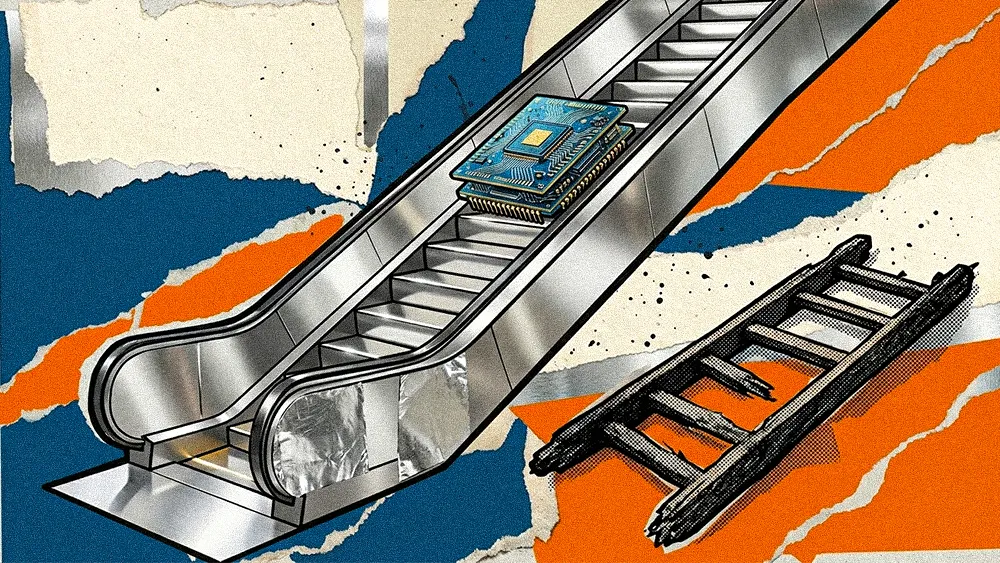
A few weeks ago, Elena Verna posted something on LinkedIn that lit up every corner of the tech internet. Verna is the growth operator behind Dropbox, Miro, Amplitude, and SurveyMonkey, and most recently head of growth at Lovable. The career flex, she wrote, used to be becoming a VP and moving up the corporate ladder. Now the real flex is going back to being an Individual Contributor.
She wrote this piece from the inside. In her own words on her Substack, she describes moving into an IC role at Lovable with no direct reports, defining what she calls the "High-Impact Individual Contributor" or HI-C: "An individual contributor who can complete a project that delivers business value, end-to-end, on their own. Usually an ex-leader (manager, director, VP)." As growth analyst Aakash Gupta noted in a breakdown of Verna's shift, she reportedly shipped Lovable's enterprise pricing page to production herself, skipping the PRDs, the stakeholder loops, the design handoffs, and the engineering backlog entirely. Gupta estimates roughly 90% of her time is now spent building, with almost no meetings.
It's a great personal essay, but what makes it really worth paying attention to is everything happening around it, because Verna is actually describing a shift that now has data, corporate policy, and compensation math behind it.
ClickUp Just Put a Price Tag on It
Shortly after Verna's post went viral, ClickUp made the subtext explicit. On May 21, CEO Zeb Evans announced that the company had cut 22% of its workforce and that the savings wouldn't go to the bottom line, it would instead be invested into the people who stayed, in the form of million-dollar salary bands.
These are not million-dollar equity packages or stock options that vest over four years if the IPO goes well. These are cash salary bands reaching seven figures, available to anyone at the company who produces "100x impact by creating or managing AI systems," per The Next Web's reporting.
Evans outlined three categories of employee he considers essential to what he's calling the "100x org." The first is builders, which he splits into 10x engineers and 10x product managers. His claim, as StartupHub.ai reported, is that the best engineers are no longer writing code themselves. They're directing agents that write code. The skill that matters is judgment and orchestration, not typing speed. The second category is system managers: people who automate their own jobs and become owners of the resulting workflows. The third is front-liners who work directly with customers. Everyone else, in Evans's framing, is structurally obsolete.
The logic is simple enough: ClickUp now runs roughly 3,000 internal AI agents across its departments, a 3:1 ratio of agents to employees. If one person can build or manage systems that produce the output of a conventional team, it makes more economic sense to pay that person like scarce infrastructure than to maintain the team they replaced.
This isn't a fringe or early-stage startup experimenting with org design. ClickUp** is valued at $4 billion with approximately $300 million in ARR and is reportedly eyeing an IPO. When a company at that scale tells the market that the path to a million-dollar salary runs through IC work, not management, it effectively rewrites the incentive structure for everyone paying attention.
The Flattening Has Numbers
ClickUp's move may seem dramatic, but it didn't appear out of nowhere. The trend it's riding has been building for two years and carries real institutional weight.
Gartner predicted that through 2026, 20% of organizations would use AI to flatten their organizational structures, eliminating more than half of current middle management positions. Their reasoning was mechanical: a large portion of middle management work consists of reading reports, analyzing data, and translating information between layers of the organization. Those are precisely the tasks that AI handles well, and at a fraction of the cost.
That prediction is playing out. Fortune reported that Amazon cut 14,000 corporate jobs in late 2025, roughly 4% of its white-collar workforce, and the cuts landed squarely on middle management, not the warehouse floor. IBTimes reported that Meta has been converting engineering managers back into IC roles focused on hands-on technical work like coding, system design, and product development. Block cut approximately 4,000 employees, about 40% of its workforce, after which CEO Jack Dorsey and Sequoia's Roelof Botha co-authored an essay titled "From Hierarchy to Intelligence" arguing that corporate hierarchy has always existed to solve one problem, routing information through organizations too large for any single person to oversee, and that AI now handles that problem better than humans.
The Q1 2026 layoff numbers tell the aggregate story. Per Invezz, tech layoffs hit 81,747 in the first quarter alone, already reaching roughly half of all of last year's total cuts. The roles disappearing are concentrated in coordination-heavy functions: customer support, quality assurance, content moderation, and above all, middle management. Meanwhile, machine learning engineers, AI safety researchers, and data infrastructure specialists remain in chronic shortage. The industry isn't shrinking. It's reorganizing around a different unit of value.
The Manager-to-IC Ratio Is Collapsing
One data point truly captures the speed of change. A senior AI leader cited by IBTimes noted that the manager-to-subordinate ratio at some AI-native organizations has moved from 1:8 to 1:50. That's the elimination of an entire layer.
Shopify CEO Tobi Lütke made this logic official policy in April 2025, telling employees in a widely shared internal memo posted to X that teams must demonstrate why AI cannot perform a task before they're allowed to ask for more headcount. AI usage became part of performance reviews. The expectation was not optional.
Klarna followed a parallel path. Per its IPO filing, the company shrank from over 5,500 employees to just over 3,400, while annual revenue per employee roughly doubled from about $344,000 in 2022 to $821,000 in 2024. Though Klarna's CEO later admitted that cost had become "too predominant" a factor and started hiring humans again, the efficiency gains were real while they lasted, and the signal to the market was permanent.
Meta took it further. Per The AI-Native Company's tracking of CEO memos, Meta announced that "AI-driven impact" would become a formal part of all performance reviews starting 2026, the first major tech company to codify AI usage into employee evaluations at that scale.
Why Compensation Is the Real Story
Verna's post resonated because it named a feeling. But the feeling wouldn't matter without the money. For decades, the financial architecture of corporations made management the only rational career move for ambitious people. You could be the best engineer, designer, or strategist in the building, but at some point you hit a ceiling unless you were willing to manage people. Verna described this dynamic vividly in her Substack: a Netflix recruiter once disqualified her because she only had 3 direct reports instead of 15. The #1 metric wasn't output or budget managed, just headcount.
That architecture is cracking. According to HR Oasis's analysis of compensation data, there's now rough pay parity between Staff Engineer and Engineering Manager, between Principal Engineer and Director, and between Distinguished Engineer and VP at top tech companies. Staff and Principal Engineers at leading firms regularly out-earn engineering managers by 15 to 25 percent, because their pay is tied to technical impact rather than organizational scale.
ClickUp's million-dollar salary bands may be most aggressive version of this shift yet, but they reflect a logic that's already embedded in how the best companies think about talent. If a single operator with AI leverage can generate the output of a department, the old comp model, where you pay managers more because they "own" more people, stops making sense. You pay the person who builds the system and not the person who managed the team the system replaced.
The One-Person Company as Proof of Concept
If the IC-as-VP trend were limited to reshuffling roles inside existing companies, it would be interesting but incremental. What makes it feel permanent is that the same dynamics are producing entirely new organizational forms.
Midjourney generates over $200 million in annual recurring revenue with roughly 11 employees, working out to about $18 million in revenue per employee. Pieter Levels runs a portfolio of products generating over $3 million a year with zero employees. An estimated 36.3% of new ventures in 2026 are solo-founded. On Alibaba's platform, 30 to 40% of sellers are now solo founders using AI agents to handle product listings, marketing, customer service, and logistics.
Jensen Huang revealed at NVIDIA's GTC 2026 that the company runs 100 AI agents per human employee, 7.5 million agents serving 75,000 humans. His framing: "In the future, the IT department of every company is going to be the HR department of AI agents."
These are very clear demonstrations of the same principle Verna is living inside Lovable: one sharp operator with leverage and an AI skillset can create output that used to require a department. The difference between the one-person company and the HI-C inside a larger organization is just a matter of where you choose to apply that leverage.
What This Actually Means for Careers
The tempting conclusion here is that management is dead. It isn't. Decision-making, context-setting, and the kind of strategic judgment that comes from seeing the whole business still carry real weight. What's dying is pure coordination and information-routing as a full-time job. The meeting about the meeting. The status update about the status update. The layer of the org chart that existed to translate between the people doing the work and the people deciding what work to do.
Dorsey and Botha put it directly in their essay. They emphasized that humans would still play a critical role, particularly in ethical decisions, strategic direction, and complex situations requiring judgment, but that humans would operate "at the edge" of the organization while AI manages coordination and operational intelligence.
Verna's framing in her Substack is more personal but cuts to the same place. The question she asked herself when making the move: "Did I just level up, or did I just give up status?" Her answer, several months in, is that she leveled up.
The career flex used to be managing people and now it's replacing the need for them to be managed at all.
The Uncomfortable Question
If you're already senior, already sharp, already the person your team quietly relied on to actually get things done, constantly experimenting and carrying a rabid curiosity for how to scale systems, this all sounds great. Fewer meetings. More craft. Better money. And for people like Verna and the ClickUp employees who made the cut, it probably is great.
The standard worry is that this is where the story ends. Gartner flagged it alongside the predictions: when middle management disappears, mentoring and learning pathways break, and junior workers lose the development ladder that turned them into senior workers. The people thriving in the HI-C model are, almost by definition, already senior. Ex-VPs, ex-directors, people who spent years building the judgment that lets them operate end-to-end. Strip out the middle rungs, the thinking goes, and you get an organization that's incredibly productive today and has no pipeline for tomorrow.
But that worry assumes the structure was what made those people good, when really it was just the toll they paid to get access. The years inside the org chart weren't wisdom accumulating. They were the price of admission to tools and authority that sat at the top and now that bottleneck is gone. The leverage that used to take fifteen years to earn now comes from a skillset you can pick up this year. A sharp 24-year-old with the right AI fluency can ship what used to take a department, without ever sitting through the decade of meetings that used to be the cost of entry.
Klarna's reversal is the cautionary half of this. After months of the most aggressive AI-first positioning in the industry, the CEO admitted quality had dropped and started hiring humans again. The lesson isn't that AI doesn't work. It's that the transition is harder than flipping a switch, and the playing field doesn't level cleanly or all at once.
The trend, though, is real. The question isn't whether the IC who builds systems is becoming more valuable than the VP who manages people. The data already answered that. The more interesting question is who gets to be that IC, and the surprising answer is that it may no longer take a title, a tenure, or ten years of waiting.
**the author of this article and editor-in-chief of State of Brand, Melissa Rosenthal, previously was the CCO of ClickUp.