Gartner Sold Three Review Sites for $110 Million. G2 Now Owns Half of What AI Says About Your Category.
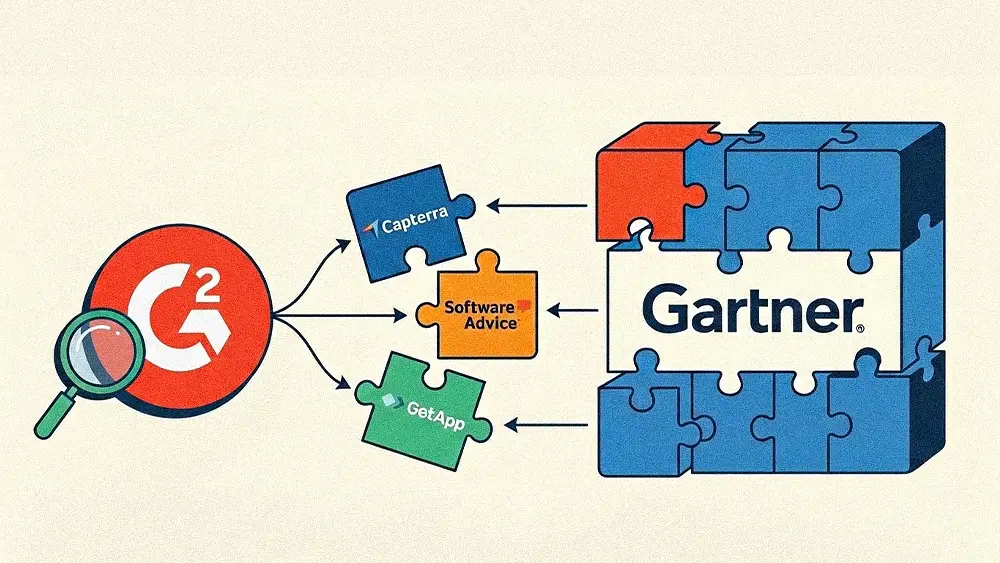
Gartner sold three review sites to G2 for $110 million. Citation data since suggests one company now supplies most of the evidence behind AI software recommendations.
Make State of Brand one of your go-to sources on Google

The number never appeared in a press release.
G2 announced on January 29 that it had agreed to buy Capterra, Software Advice and GetApp from Gartner. The announcement ran long on vision and said nothing about money. The deal closed a week later, on February 5. The figure surfaced two weeks after that, in Gartner's 10-K, described as approximately $110 million before customary purchase price adjustments.
A hundred and ten million dollars. For three of the properties that machines now consult before telling a buyer which software to shortlist.
What Gartner thought it was selling
The case for the sale was straightforward and, on its own terms, correct.
Gartner bought Software Advice in 2014 and assembled Digital Markets around it. As MarTech's Mike Pastore put it when the deal was announced, the fit had always been awkward: Gartner's core business is high-value independent research and advisory work, while Digital Markets ran like a media business driven by paid placements, lead generation and SEO. Two different companies wearing one logo.
Then the media business stopped working. Organic traffic to the software review category fell off a cliff between early 2024 and the end of 2025. SE Ranking's analysis found declines running past 80% and in some cases past 90% across the major platforms. An asset whose entire model was capturing early-stage buyer research had lost the traffic that made it work.
Gartner was also having a bad year. Its stock was down more than 60% over the preceding twelve months as contract growth and renewals slowed. Selling a non-core media property to refocus on the research franchise is the most defensible move in the corporate playbook.
So Gartner sold a declining traffic business. That is a reasonable description of the transaction and probably how it was modeled internally.
It is not what the buyer got.
The traffic collapsed and the influence went up
SE Ranking studied 30,000 commercial keywords and more than 211,000 cited links in Google AI Overviews. Review platforms turned up in a large share of commercial answers, and five of them accounted for 88% of all review-platform citations: Gartner Peer Insights at 26.0%, G2 at 23.1%, Capterra at 17.8%, Software Advice at 12.8% and TrustRadius at 8.3%. The researchers also noted there was no meaningful correlation between a platform's AI citation share and how much organic traffic it had managed to keep. The platforms bleeding the most human visitors were still being cited constantly.
Those two facts are not in tension. They are the same fact stated twice. The engines absorbed the research function that used to send people to these sites, and in absorbing it, they started quoting the sites instead. The audience left. The influence stayed, and moved somewhere marketers cannot see.
Map G2's purchase onto that list and the concentration is obvious. G2, Capterra and Software Advice together represent 53.7% of review-platform citations in AI Overviews. One company, one commercial model, more than half the category.
The number moves depending on who is counting. Profound data published by G2 itself, based on roughly 35,000 ChatGPT citation URLs, puts the combined portfolio at 84% of review-platform citations, and found the share climbs as purchase intent gets stronger. Modeling by Omniscient Digital across 25,755 citations suggested the acquisition would lift G2's bottom-of-funnel citation share by 76% and move it to the second most-cited domain in that context, behind only Reddit. Different panels, different engines, different answers. The direction is not in dispute even where the decimal places are.
Gartner kept the most-cited one
The easy version of this story is that Gartner mispriced an asset and G2 stole it. The easy version is wrong, and the correction is the most interesting thing in the deal.
Gartner retained Peer Insights. In SE Ranking's data, Peer Insights is the single most-cited review platform of the five, ahead of G2 itself. Gartner sold the three properties that monetize through vendor placement and lead generation, kept the enterprise-weighted one that sits closest to its analyst franchise, and exited a media model that AI was already dismantling.
Read that way, Gartner did not fail to understand what it owned. It understood exactly which part of it was a business it wanted to keep running and which part was a business it did not. The $110 million looks small against the influence transferred, but Gartner was not selling influence. It was selling a revenue line with a collapsing acquisition channel, and it held onto the citation share.
G2 bought the concentration. Godard Abel described the goal in the announcement as building the definitive system of record for B2B software in the age of AI, which is an unusually candid statement of intent. The company also said the combined data would enable up to three times more buyer intent signals and a new pay-per-lead offering.
The neutrality problem
This is the part that matters to anyone who thinks about brand rather than pipeline.
Language models lean on review platforms for a specific reason. A vendor's own site is understood to be self-interested. A third-party platform carrying verified user reviews reads as independent corroboration. The engines are applying a heuristic that has served people well for twenty years: if the source is not the seller, weight it higher.
The heuristic has a gap in it. Not owned by the vendor is not the same as not funded by the vendor.
Review marketplaces run on vendor money. Enhanced profiles, category placement, badges, intent data, lead packages. Now pay-per-lead. This is not a scandal and it is not hidden; it is the disclosed business model of a category that has operated this way for a decade and that most B2B marketers already budget for. The reviews themselves come from real users and the platforms run detection against manipulation.
But the machine cannot see any of that. It sees a domain that is not the vendor's domain, and it assigns trust accordingly. What the engines are actually treating as neutral evidence is the output of a marketplace where the companies being evaluated are the customers.
We made a version of this argument on Monday about Reddit, where the citation value depends on threads being unpaid and unscripted, and a market has emerged to make them neither. The review layer is the same structural problem with better paperwork. On Reddit the commercial interest is undisclosed and against the rules. Here it is disclosed, contractual and completely invisible to the only reader that now matters.
What this actually changes
Practically, three things.
Your review strategy is no longer a bottom-funnel checkbox managed by a demand gen coordinator. G2's own 2026 buyer research found review sites became the top source shaping which vendors make a shortlist, at 38%, narrowly ahead of AI chatbots at 37%. Those two numbers are not separate channels. The chatbot is reading the review site.
Your negotiating position with that layer just got worse. When four properties competed for the same citations, a vendor could shift budget between them. Three of them now share an owner, a roadmap and a rate card. TrustRadius went to HG Insights last June. The independent options are thinner than they were eighteen months ago.
And the thing you cannot buy is still the thing that decides it. Reviews get cited when there are enough of them, recent enough, specific enough, from customers willing to write at length about a product that changed something for them. That is a function of whether the product is good and whether anyone at the company has asked. No amount of profile spend manufactures it.
The uncomfortable read on this deal is that a category built to give buyers independent evidence has become the primary evidence machines cite, at the exact moment its independence became impossible for those machines to evaluate. Gartner got out of the business. G2 consolidated it. Neither of them did anything wrong, and the outcome is still a problem, which is usually how the important ones look.

If this caught your attention, that’s not accidental.

The best editorial systems don’t happen by accident. Outlever builds them.

If this caught your attention, that’s not accidental.

The best editorial systems don’t happen by accident. Outlever builds them.


Come back for the reason it lands.
Subscribe for the kind of thinking that makes people stop, read and come back.