Ford Rehired 350 Veteran Engineers After AI Couldn't Fix Its Quality Problems
The automaker spent three years bringing back the experts it once let go. It just topped J.D. Power's quality ranking for the first time in 16 years.
Make State of Brand one of your go-to sources on Google

The popular AI story is typically a subtraction story. Companies trim headcount, hand the work to software, and report the savings. Ford ran the experiment the other direction, and the lesson it learned is one a lot of executives would rather not hear out loud.
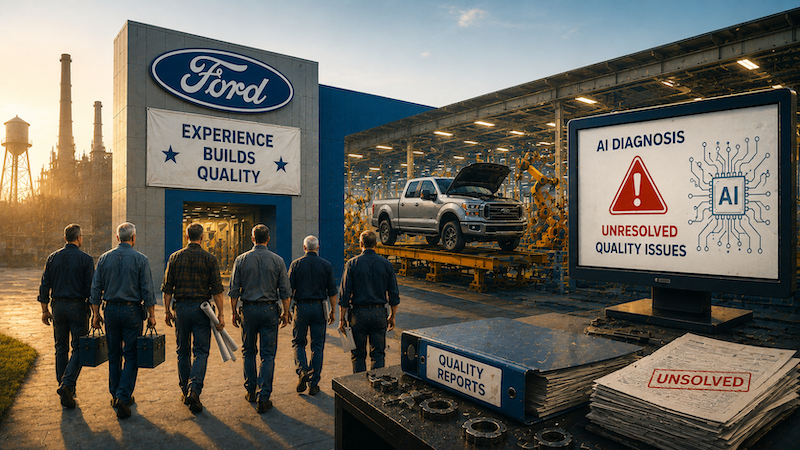
Ford has hired or rehired more than 350 veteran engineers over the past three years, the people it calls "gray beards" internally, to fix quality problems that had cost it billions and that automation alone could not crack. Many were former employees. Some came from suppliers. Those engineers now run mandatory troubleshooting meetings and have reprogrammed Ford's AI tools to head off glitches before they happen.
The payoff landed on Thursday, when Ford ranked first among mainstream brands in the latest J.D. Power Initial Quality Study, its first time at the top in 16 years. The result put it above the names that usually own that list, Toyota and Honda. CEO Jim Farley used the moment to point at the payoff that matters to the balance sheet: lower recall costs and lighter warranty coverage.
The admission underneath the trophy
What makes this more than a feel-good comeback is how plainly Ford's leaders described the mistake that came before it.
Chief operating officer Kumar Galhotra said the company had been leaning more and more on automated quality systems without getting the results it wanted. The veterans, he said, were brought back as specialists who hunt for failure points before a part ever reaches the plant floor, and he called them the heart of the turnaround.
Charles Poon, Ford's vice president of vehicle hardware engineering, was blunter about the original miscalculation. Speaking on a call with reporters, Poon said artificial intelligence is only as good as the data you train it on, and that the deeper error was assuming the tool could stand in for the people who understood that data. Ford had mistakenly believed that feeding AI its existing design requirements would be enough to produce a high-quality product. He admitted the company had not paid enough attention to its most experienced engineers, the ones who had lived through many product cycles and knew where things tend to break.
That is the part worth sitting with. The institutional memory was not a line item to be optimized away. It was the missing training data.
This is not Ford abandoning AI
The easy read here is that automation failed. That is not what happened, and brand leaders watching this should not draw that conclusion.
Ford added more than 100,000 AI-powered tests and built a 40-person software quality assurance team as part of the same effort. The veterans did not replace the machines. They retrained them and fixed the workflows feeding them. The bigger structural shift was a move away from a reactive "find and fix" model toward catching warning signs upstream and forcing engineering, software, manufacturing and supply-chain teams to stop working in isolation.
In other words, Ford did not choose people over AI. It learned that the AI was only as capable as the experience standing behind it, and it had let too much of that experience walk out the door.
The footnote the press release leaves out
A quality ranking does not erase the underlying numbers, and an honest read keeps them in view. Ford is still the most recalled automaker in America and expects roughly $1 billion in warranty and materials costs this year. Galhotra's response is that recalls lag reality, and that because the company is doing more to prevent issues upfront, those numbers should fall steadily on newer vehicles.
He may be proven right. But the J.D. Power study measures initial quality on new cars, not the reputation Ford has to rebuild across the vehicles already on the road. The brand win is real. It is also early.
What this means for everyone else
For any leader who has spent the last two years pitching AI as a way to shed expensive senior talent, Ford has handed over an unusually public case study in the cost of getting that wrong. The thing the gray beards brought back, knowing where a part fails before it fails, is exactly the kind of accumulated judgment no model produces on its own, and exactly what a company stops generating the moment it lets the people who hold it go.
The takeaway is not to avoid AI. It is that the experience many companies treat as a legacy cost is often the input that makes the technology work in the first place. Ford spent billions learning that the hard way, then spent three years and 350 hires buying it back.

If this caught your attention, that’s not accidental.

The best editorial systems don’t happen by accident. Outlever builds them.

If this caught your attention, that’s not accidental.

The best editorial systems don’t happen by accident. Outlever builds them.


Come back for the reason it lands.
Subscribe for the kind of thinking that makes people stop, read and come back.