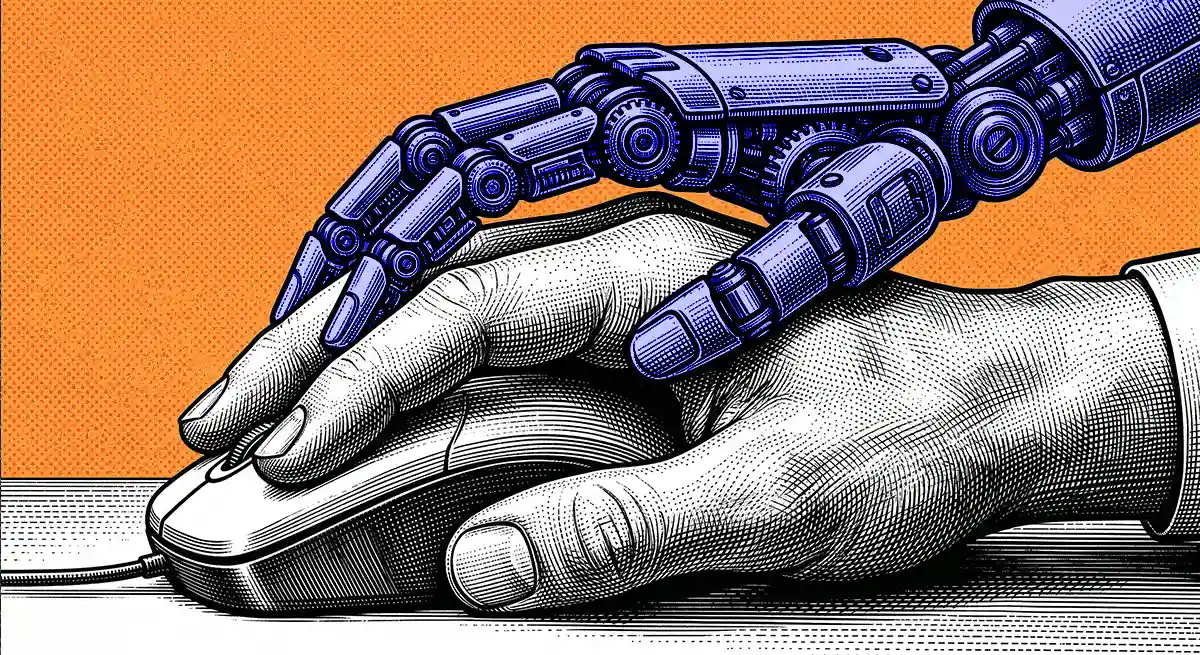
There is a moment in every technology cycle when the industry settles on a word and then wears it down to nothing. It happened to "smart." It happened to "cloud." It happened to "copilot," which went from a genuinely evocative product name to a suffix you could bolt onto anything with an API key. Now it is happening to "coworker," and faster than any of the others.
Anthropic ships Claude Cowork. A San Francisco startup formerly known as Village Labs rebrands itself, simply, as Coworker. Enterprise vendors publish explainer pages defining the "AI coworker" as a category in its own right. Analysts produce copilot-versus-coworker taxonomies. HR software companies announce they are "onboarding" digital employees. Somewhere in a pitch deck right now, a founder is typing the phrase "your AI coworker for X," confident in having found the framing that finally makes the product legible.
They have. So has everyone else. That is the problem.
The metaphor was doing real work, briefly
In fairness to the word, "coworker" earned its moment. It marks a genuine conceptual shift. "Assistant" implied something subordinate and reactive: you ask, it answers. "Copilot" implied something parallel but supervised. It suggests, you decide. "Coworker" implies an entity that takes ownership of work, operates with some autonomy, and occupies something like a seat. The word was not chosen at random. The technology changed, and the older metaphors stopped fitting.
There is also a commercial logic humming underneath it. An assistant is a feature. A coworker is headcount. The metaphor quietly reframes the budget conversation, because nobody compares a coworker to the Slack bill but they compare it to a salary. Strip away the friendliness and 'coworker' is a pricing strategy wearing a name tag.
So the first companies to use it were actually saying something. The word carried information. This is not a chatbot, it told buyers, this is a delegate. For a few months, "coworker" was a differentiator.
Then comes the great flattening
Naming language behaves like currency, and the AI industry prints fast. When one company calls its product a coworker, the word distinguishes. When forty companies do, it merely categorizes. When four hundred do, it stops doing even that and becomes ambient noise, the linguistic equivalent of stock photography. You read "your AI coworker" on a landing page and your eyes slide off it the way they slide off "we're passionate about innovation."
Linguists have a term for what happens when a word is repeated until it dissolves into sound: semantic satiation. Markets have their own version of the same effect. Call it category satiation, the point at which a metaphor has been adopted so universally that it no longer transmits any signal about any individual product. Every coworker-named tool is implicitly making the same promise, which means none of them is making a promise at all.
Notice the strange inversion at work here. Traditional brand strategy spends enormous energy avoiding genericide, the fear that a distinctive name like Kleenex or Xerox will collapse into the generic term for its category. The AI naming gold rush runs that process backwards. Companies are deliberately adopting the generic term as the brand, hoping to own the category by squatting on its noun. Coworker-the-startup is the purest expression of this, a company whose name and category are the same word. It is a land grab, and land grabs only pay off if you can hold the land. You cannot trademark your way into owning a common English word that a hundred competitors are using descriptively. The moat is a puddle.
What the flattening costs
The obvious casualty is differentiation. If your name is the category, your name does none of the work of explaining why you, specifically, exist. But the subtler losses deserve more attention than they get.
The first is precision. These products are not actually the same. Some are autonomous agents that execute multi-step workflows. Some are desktop apps that organize files. Some are glorified search layers over a company wiki. When all of them are "coworkers," buyers lose the vocabulary to tell them apart, and the gap between what the word promises and what the median product delivers becomes a shared liability. Disappointment of that kind does not attach to one brand. It attaches to the word, and through the word to the whole category.
The second is honesty. "Coworker" is an anthropomorphizing word, and anthropomorphism is a choice with consequences. Recent workplace research suggests that treating AI systems as colleagues, complete with org chart entries and Slack avatars, can erode human accountability as people offload responsibility onto entities that cannot hold it. Whether or not that research proves conclusive, it points at something brand strategists should take seriously. The metaphor is not neutral packaging. It shapes how people relate to the product, what they expect of it, and what they forgive it for. An industry that flattens all of its language into "coworker" is also flattening a fairly important conversation about what these systems actually are.
The third is what the convergence signals. When every company in a market reaches for the same word at the same time, the naming is not coming from product truth. It is coming from competitive anxiety. Category-name conformity is follower behavior, and the brands we remember from previous platform shifts tend to be the ones that refused the consensus noun. Nobody called it "the MP3 player." Somebody called it an iPod.
So what comes after "coworker"?
This is where the question genuinely stays open, because the answer is not obvious.
One possibility is that the word completes its life cycle and dies into pure infrastructure, the way "smart" did. "AI coworker" becomes an unremarkable descriptor on a spec sheet, and brands differentiate elsewhere: on personality, on proper names, on the specific job done. The school of naming agents like individuals, as Engine does with Eva and Mae, hints at this future. If the category word is exhausted, give the thing an actual name.
Another possibility is darker for the metaphor's fans. "Coworker" may get quietly retired not because it wore out but because companies stop wanting to say it out loud. A word that frames software as headcount is a word that frames software as headcount replacement, and a moment may arrive when that is a connotation nobody wants on a homepage.
A third possibility, the one worth rooting for, is that the exhaustion of the category noun forces the industry back toward actual brand-building. Distinctive names. Specific claims. Language that risks meaning something, because language that risks nothing communicates nothing.
What seems certain is the pattern itself. The great flattening does not end with "coworker"; it simply moves on to its next word. The industry will find one. It will be vivid for a quarter, useful for a year, and dead within two. The companies that win will not be the ones that adopted it fastest but the ones that never needed it.
A name is supposed to be the one thing about a product that nobody else can say. "Coworker" was never going to be that. Everyone could say it, and now everyone does, which is exactly why it has come to say so little.